"I used to go to calligraphy classes since kindergarten, and I practiced for a long time, but I left the calligraphy class when I was a teenager. However, when I became a member of society, I was worried about my handwriting disorder, so I went to calligraphy class again because I wanted to learn it in earnest again. The teacher I met there was a teacher of ink elephants, and that was my encounter with the world of ink elephants."
Sorasaki Inoue said that he had been learning calligraphy since he was a child. I'm sure what you call "disturbing characters" must have been much more beautiful characters than we think. However, I am sure that he also liked calligraphy from within, and his passion for writing may have led Sorasaki Inoue to the gate of the calligraphy class again.
Regarding the avant-garde book "Sumizo" for traditional books such as kanji and kana calligraphy, Sorasaki Inoue, who is a writer of ink elephants, explained it as follows.
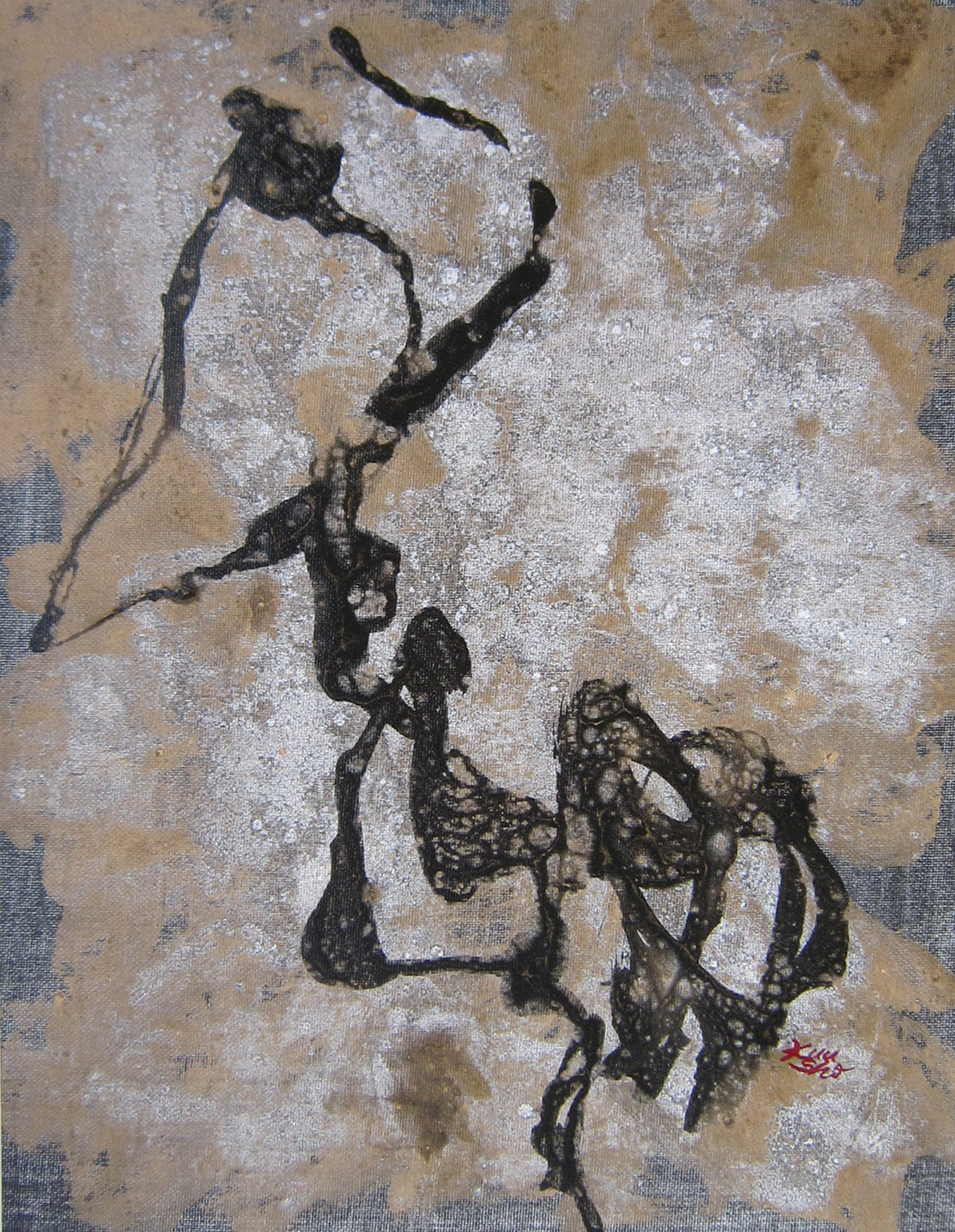
"Genres called avant-garde books and ink elephants were born after the war. It is mainly divided into literal and non-literal expressions. Literal expression is to express oneself by deforming while retaining the original letters, and non-literal expression is to visualize it far away from the letters. I don't just do one or the other, but I draw both literal and non-literal expressions depending on the time of the day.
As someone who had only practiced calligraphy by writing fixed characters according to a model, the world of ink elephants was too surprising. Break the letters? Don't write evenly? I felt like I didn't understand why. Although I was surprised, I learned the fun of expressing myself by adding alpha to the original shape of the letters. As I admired various ink elephant works, I became fascinated by the world of ink elephants, thinking, "It's okay to be free like that" and "It's okay to go this far." I hope that people who encounter the world of ink elephants for the first time will think and enjoy it in that way."
InterviewFeatured Artist
Sora Inoue
He continues to pursue his unique line quality and the sound of the margins.
Encounter with a "ink elephant" full of surprises
Put expression on the power of the letters themselves.
"Literal and non-literal expressions are based on the mood at the time, and I choose the one I want to express at that time. It is not a decision on one or the other, but it is important to express the power of the letters themselves.
The letters themselves have meaning. The meaning of kanji itself also has meaning. The kanji has a form, but with the help of that fixed form, we will accumulate plus alpha. Add your own expression to the meaning of kanji and add inspiration to the form of kanji. I think that by putting it on the framework of kanji, something strong will be created. This time, I am thinking about what to write, which letters to choose to express, and the idea for such works every day. When I face such an abstract image in front of the paper, there is something that springs up, so I express it to the fullest."
As he talked about what he wanted to express on the ink image, he naturally uttered the phrase "the power of the letters themselves." Isn't the expression unique to those who are fascinated by letters and words the ink image?
"What I am careful about is "writing lines that are typical of Sorasaki Inoue" and "valuing the sound of the margins". In the world of ink elephants, there are people who use color in their works and people who don't. I use or don't use color depending on how I feel at the time. Many people use only brushes to express themselves, but I am willing to use what I want to express at that time. I sometimes tear cardboard and use it, or use tree branches to make it. However, no matter what kind of tools and tools I use, I don't "paint", but stick to "drawing lines". Once I put down the brush, I write it in just a few minutes and seconds. The art of lines born from tension that cannot be rewritten. This is because I think that is "calligraphy"."
I want you to know the ink elephant. I want the viewer to see it as they wish.
"When I create my work, I express my thoughts at that moment on my brush, but when I exhibit it, I am happy when the work becomes the viewer's property and walks alone into that person's world. I hope that I can evoke various emotions in the viewer through my work rather than my own thoughts. There are things in the work that are overwhelmingly powerful and intimidating, and on the contrary, there are things that draw you into them. I want my work to be the latter.
I want to stare at it comfortably forever. I want to continue to create such works."
Sorasaki Inoue says that he expresses his feelings at that time as they are. I felt that Sorasaki Inoue's desire to cherish the afterglow of the margins and his desire to create a work that can be slowly immersed in are very compatible.
"Sumizo is also called an art book, and the interesting thing about non-literal expressions is that when Japan customers look at it, they sometimes say, "What does this say?" or "I don't know how to look at it if it's not characters," while ......overseas people tend to look at it more freely. I would like more people to know about the ink elephant and see it freely. Rather than thinking about what is written, I want you to look at it as you like, even if you think "it's beautiful", "the shape is interesting", or "it doesn't feel disgusting". I would be happy if you could enjoy the works of the ink elephant without thinking too hard.
Sorasaki Inoue says that he expresses his feelings at that time as they are. I felt that Sorasaki Inoue's desire to cherish the afterglow of the margins and his desire to create a work that can be slowly immersed in are very compatible.
"Sumizo is also called an art book, and the interesting thing about non-literal expressions is that when Japan customers look at it, they sometimes say, "What does this say?" or "I don't know how to look at it if it's not characters," while ......overseas people tend to look at it more freely. I would like more people to know about the ink elephant and see it freely. Rather than thinking about what is written, I want you to look at it as you like, even if you think "it's beautiful", "the shape is interesting", or "it doesn't feel disgusting". I would be happy if you could enjoy the works of the ink elephant without thinking too hard.